SketchUp 2026.1
26.1.185 Win 64-bit
26.1.184 Mac 64-bit
What’s New in SketchUp 2026.1?
- SketchUp AI – SketchUp’s new AI services are designed to complement, enhance, or optimize what you already do in SketchUp. SketchUp 2026.1 introduces the following new features:
- AI Render – Generate photoreal images from your model viewport with either your own custom prompt or using one of SketchUp’s presets. You can then refine your results using powerful in-painting tools.
- AI Assistant – A new entry point for AI-powered workflows in SketchUp. AI Assistant contains Help Assistant, a tool providing in-app guidance to your questions, and Generate Object, a way to create 3D objects with PBR textures from your text prompts and images.
- AI Credits – SketchUp AI features are powered by AI Credits. All paid subscriptions include a set amount of credits. If you need more, the new SketchUp AI add-on subscription offers a substantial boost to your available credits.
- Migrate Preferences – The new Migrate Preferences feature helps you transfer all of the customizations you’ve made in the Preferences dialog when updating to a new version of SketchUp.
- Tape Measure Guide Points – New modes added to the Tape Measure tool to help you define guide points at a specific distance from another reference point in your model, similar to creating guide lines.
- PDF Import for Windows – SketchUp can now import PDFs into SketchUp with no need to convert those files to another supported file type.
- Bug Fixes, Changes, and Improvements
SketchUp AI
What We Did
SketchUp’s new AI services, AI Render and AI Assistant, are designed to compliment, enhance, or optimize what you already do in SketchUp. Along with these new features, we are also introducing the SketchUp AI subscription to offer even more opportunities to use these features and achieve your design goals.
The Details
Generative AI is transforming the way Design, Engineering, and Construction professionals get things done. SketchUp’s AI tools integrate this technology into the SketchUp you know and love to help accelerate your workflows.
AI Render
Whether you are suffering from a block in your creative process, need some extra visuals to help support the narrative you’ve established in your project, or just want to fully express your unique creative vision, AI Render can help.
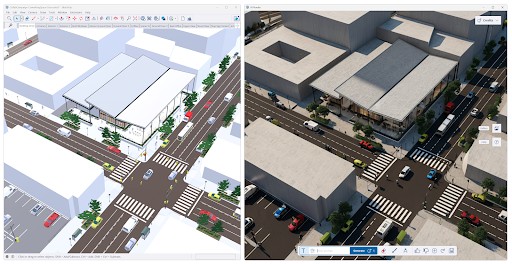
AI Render lets you combine an active model’s viewport with a text prompt or preset style to create a new, AI-generated image. With the options available in AI Render you can:
- Generate quick photorealistic images.
- Define the visual style of your AI-generated images.
- Control how much, or how little, your text prompt influences the output.
- Mask over certain areas of your generated image to erase, add, or sketch elements.
- Use a reference image to define the stylistic output of your generated image.
- Overlay the AI-generated output on top of your SketchUp model, creating a scene you can refer back to later.
- Save the AI-generated output for use outside of SketchUp.
AI Assistant
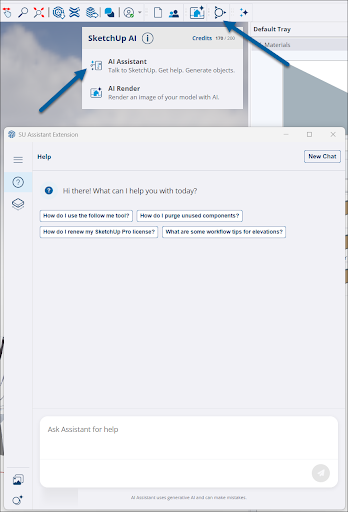
The AI Assistant ( ) extension brings access to AI-powered workflows without leaving SketchUp. To get started with AI Assistant, open SketchUp AI (
 ) and select AI Assistant or from the menu by selecting Extensions > AI Assistant.
AI Assistant offers a few different ways to bring AI into your workflow:
- Help(
 ) – Ask questions about tools, best practices, or even complex workflows and get in-app guidance.
 - Generate Object (
 ) – Enter text prompts or provide your own image and add prompts to create 3D objects with photoreal materials.
AI Credits
SketchUp’s AI tools can help enhance your workflows and designs. Using these tools to generate output uses SketchUp AI Credits. These credits represent the cost of the computational power each tool uses.
Each SketchUp subscription tier includes a set number of credits you can use each month:
- Free – No credits are included with a free subscription.
- Go – 100 credits per month
- Pro – 150 credits per month
- Studio – 200 credits per month
If you need more credits than your subscription provides, you can add on a SketchUp AI subscription that gives you access to an additional 1500 monthly credits.
Learn More
For more information on SketchUp’s new AI features, see SketchUp AI.
Migrate Preferences
What We Did
The new Migrate Preferences feature helps you transfer all of the customizations you’ve made in the Preferences dialog when updating to a new version of SketchUp.
The Details
Many SketchUp users set up the options in the Preferences panel to help streamline their modeling workflows. The new Migrate Preferences utility provides a quick and efficient way to transfer all of those settings. Combined with the Migrate Extensions tool, you can transfer your extensions, tools, and workspace settings immediately after updating SketchUp.
To get started, we recommend running the Migrate Extensions utility first. After migrating your extensions, restart SketchUp and click File > Migrate Preferences.
Learn More
See Migrating After Updating for more information on how to transfer your workflows and settings to the newest version of SketchUp.
Tape Measure Guide Points
What We Did
New modes added to the Tape Measure tool to help you define guide points at a specific distance from another reference point in your model, similar to creating guide lines.
The Details
The Tape Measure tool now includes an additional mode for creating standalone guide points. This new functionality allows you to define a guide point at a specific distance from another point in the model in the same way you create a guide.
The Tape Measure now has three modes you can cycle through when you tap Ctrl (Win) or Option (Mac):
- Measure – No guides are created but the measurements box will display distances.
- Create Guide Lines – The default Tape Measure functionality. With this mode you can create guide lines to help you draw with precision.
- Create Guide Point – Rather than creating a line, you can click in your model to create a guide point. Just like with guide lines, you can use SketchUp’s inferencing features to place and reference guide points while drawing.
You can also create guide points quickly by double-clicking to generate a single guide point at a desired location.
Learn More
For more information, see Using Guides.
PDF Import for Windows
What We Did
SketchUp users on Windows can now import PDFs into SketchUp without needing to convert those files to another supported file type.
The Details
Windows users can now import single-page PDF files into your model. To get started, select File > Import… and select a file from your device, or drag and drop a PDF file into your model viewport. Similar to SketchUp on MacOS, importing a PDF is equivalent to importing an image file. Importing vectors and layer data is not yet available.
Learn More
For more information, see Importing and Exporting Image Files.
Bug Fixes, Changes, and Improvements
SketchUp
- Fixed an issue where the “Show Welcome Window checkbox” preference would be inactive when logged in with a Studio or NFR account.
- Fixed a security vulnerability where malicious code could write out-of-bounds data.
- Changed the contextual menu when right-clicking in an empty area of the model. Previously, it said Invert Selection, now it says Select All.
- Fixed an issue where OBJ export units were incorrectly fixed to inches, despite user selection in the Options dialog. The selected unit (unless "Model units" or "Inches") reverted back to inches upon re-opening the dialog. The fix ensures selected units are retained and conversion works correctly upon export.
- Fixed an issue where user-defined file locations could fail to transfer between versions during the upgrade process.
- Fixed an issue where a user is asked to purge assets twice when uploading to 3DW if 'Ask to purge on save' is enabled
- Adjusted the sizing behavior for Live Components (LC) to be more predictable. Size handles now enforce positive values, fixing an issue where scaling an LC "through itself" resulted in unexpected or broken geometry.
- (Mac) Fixed an issue where certain extensions would result in the extension toolbar becoming uneditable and, in some cases, cause a crash.
- (Mac) Fixed an intermittent crash that could occur when opening a model from Trimble Connect when no other models are open.
- (Win) Fixed an issue where SketchUp would crash when closing if the PaintTool is active.
- (Win) Fixed a crash that can happen when a user closes SketchUp while pasting an asset.
- (Win) Fixed an issue where, in some instances, SketchUp would not display '2026' in the title bar.
- (Win) Fixed an issue where the Trial expiring notification would read as clipped text.
- (Win) Fixed an issue where users could unintentionally remove a tool from their toolbar while dragging it to a new toolbar. Users now need to deliberately r-click and delete a toolbar button while in the Toolbars menu to remove it from a toolbar.
LayOut
- You can now sort items in the References section of Document Setup.
- Fixed an issue where Dashes did not display in Vector or Hybrid rendering but did in Raster rendered viewports.
- Fixed a bug in the Experimental Graphics Engine which would dim entities outside of the group being edited.
- Fixed an issue where the auto-text update causes z-order changes in Groups.
- Fixed the behavior of the Update Table Reference function to include "All" by default.
- Fixed an issue where empty cells would not display fill color.
- Fixed an issue where the wrong scale handles remain visible when zoomed out of the page.
- Fixed a crash that could occur when rendering a viewport.
- Tables no longer support clipping masks. This was never an intentional feature of tables, so we've decided to clean this up in advance of clipping mask improvements.
- (Win) In the SketchUp Model Inspector, the Styles panel UI has been updated.
- (Win) The Commands tab within the Configure Toolbar dialog has been reintroduced, allowing for more robust custom toolbar configurations.
- (Win) Fixed an issue that occurred when using activating the Pan tool with the middle mouse wheel with highlighted text selected.
- (Win) Changed the Paper Size drop-down to be a smaller but scrollable list in Document Set-up.
- (Win) Fixed an issue where the color swatches border was too thick.
- (Win) Fixed an issue where the color well selection highlight was too light.
- (Win) Fixed an issue where the SketchUp Model inspector > Camera/Effects always expanded on launch.
- (Win) Fixed an issue where the text Style didn't allow for font search.
- (Win) Fixed an issue where the locked layer name can be edited, but didn't take the edit.
- (Win) Fixed an issue where attempting to rebind a built-in shortcut made LayOut unresponsive.
- (Win) The SketchUp Model Inspector, Tag section is now resizable.
- (Win) Fixed a crash that could happen when updating all references.
- (Win) Fixed an issue where context menu > Relink File Reference did not allow images to be selected.
- (Win) Fixed an issue where image and PDF export page range validation was not functioning correctly.
- (Win) Fixed a bug where some pages in Document Setup would not display for languages other than English.
- (Win) Font sizes will no longer apply to other selected text entities.
- (Win) Fixed the sizing of Styles folders to match Styles thumbnails in the SketchUp Model inspector.
- (Win) Fixed a bug in Pages and Layers to allow multi-select reordering.
Revit Importer (v1.2026.1.0)
- Added support for .rvt files from versions 2015 to 2026.
- Updated the plugin with a new UI for filtering by Phases and Categories, which can be manually selected or deselected.
- Revit Rooms and Spaces can now be imported as unique components, complete with their own tags and materials.
- Added a logging feature that creates a log file in the Windows Temp folder to assist support teams with troubleshooting.
- Enhanced metadata support so Revit Families Type and Instance parameters are imported as separate attributes in the Component Options dialog.
Ruby API Additions and Improvements
- Added UI.show_extension_warehouse which opens the Extension Warehouse home when called without arguments, or navigates directly to a specific extension when given its extension identifier (UUID).
- Modified Sketchup::ShadowInfo#[]= to be stricter and provide better error feedback. It will now raise a KeyError for invalid or read-only keys, and a TypeError for values of an incorrect type.
- Added built-in JavaScript callbacks sketchup.launchEW(id) and sketchup.installRBZ(url) for HtmlDialog. launchEW with a UUID string opens that extension's page. installRBZ downloads and installs the .rbz at the given URL.
- Added UI::HtmlDialog#hide to hide dialogs without closing them, preserving their state.
- In the SketchUp Ruby API, setting the field of view (fov) outside 1.0 - 120.0 using fov= triggers a warning and clamps the value, but using the Camera constructor or set method with 5 arguments previously allowed any fov value, including negatives. This inconsistency has been fixed, and a warning is now raised for invalid fov values.
Ruby API bug Fixes
- Fixed a regression in Sketchup::Tool#onKeyDown introduced in SketchUp 2026.0 (Windows) where the event didn't trigger when Return/Enter was pressed.
- Fixed a few documentation issues
- Fixed silent failures when passing non-invertible transformations (e.g. zero-scale transforms). Methods like ComponentInstance#transform!, Group#transform!,Image#transform!,Image#transformation=, Entities#transform_entities and Entities#add_instance now correctly raise an ArgumentError.